
Where My Game Stands Q1 2026 — and How I’m Going to Improve
Based on 20 rounds of GHIN data
I’ve been playing a lot of golf this winter into spring — 20 rounds logged on GHIN since December — and I finally sat down to look at what the numbers are actually telling me. Spoiler: some of it is encouraging, some of it is not, and I now have a very clear picture of exactly what’s holding me back from scoring better.
Let’s get into it.
Where My Handicap Sits
My handicap index is sitting right around 11 (11.1 to be exact), built from my 8 best differentials out of the last 20 rounds. Those eight counting rounds ranged from an 8.8 differential (an 80 at Indian Creek) down to 12.6. In terms of raw scores, I’ve shot as low as 80 and as high as 91 during this stretch.
That 11-shot gap between my best and worst rounds is probably the most honest thing the data can tell me right now. The tools are there. It’s consistency and decision-making that need work, not the swing itself.
Breaking Down Every Shot
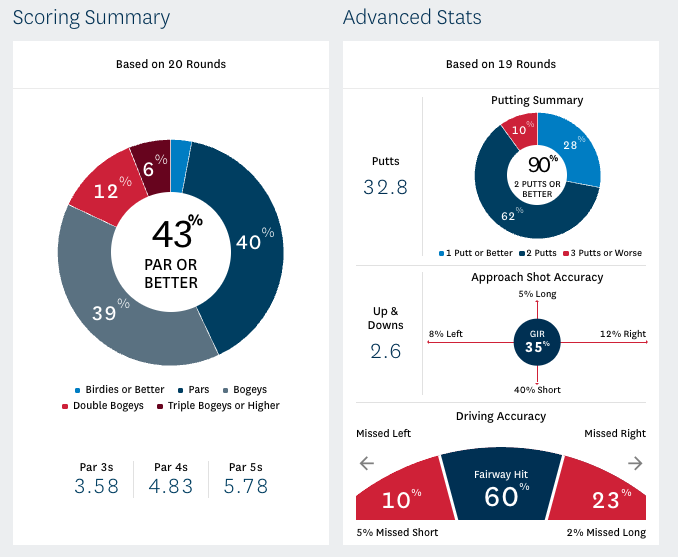
Over 20 rounds, I’m making par or better on 43% of holes. That’s a reasonable number for my handicap. Bogeys account for 40% of holes, which is fine — that’s what 11-handicap golf looks like. The problem is the other 18%.
Double bogeys are happening on 12% of holes. Triple bogeys or worse on 6%. Add those together and nearly one in five holes is a complete blowup. On an 18-hole round, that’s 3-4 holes where things fully unravel. If I can convert even two of those doubles into bogeys, I’m shooting 83 instead of 87. That’s the low-hanging fruit.
By hole type, my averages break down like this:
- Par 3s: 3.58 average
- Par 4s: 4.83 average
- Par 5s: 5.78 average
Par 5s are actually my best holes relative to par. I’m taking advantage of the length, getting up in two or three, and giving myself birdie chances. Par 3s are the opposite story. Nearly a bogey average on every par 3 is a pattern worth taking seriously, and it connects directly to something else I’ll get into below.
The Putting Problem
I’m averaging 32.8 putts per round. That’s too many. PGA Tour average is around 28-29, and while they’re hitting far more greens than me, the gap is still meaningful.
The number that really stings is a 10% three-putt rate. At 18 holes per round, that’s roughly 1-2 three-putts every single time I play. Those are essentially free bogeys I’m gifting myself. The cause is almost certainly distance control from long range — leaving myself 6-8 footers for par when a good lag putt should be a tap-in.
My one-putt rate is 28%, which is okay, and I’m converting 2.6 up-and-downs per round. But the three-putts are quietly eating up any good work I do elsewhere on the course. I do feel like this will naturally improve as we move into more consistent green conditions for the Spring and Summer months.
The Short Miss is Costing Me Everything
Here’s the big one. 40% of my approach shots are finishing short of the green. Four in ten. That is the single biggest pattern in my entire game, and it connects to almost everything else — the low GIR percentage (I’m only hitting 35% of greens in regulation), the par 3 struggles, the scrambling pressure I’m putting on myself every round.
The fix is both simple and hard: take one more club than you think you need. Every time. No exceptions. When I’m between clubs, go up. When I think I can hit a smooth 9-iron, hit an 8 and make a controlled swing. The miss will still be on the green.
On the positive side, my driving is genuinely solid. I’m hitting 60% of fairways, which is a real strength at my handicap level. I’m missing right more than left (23% vs. 10%), which could indicate a slight fade pattern, but those aren’t crisis numbers. Although it feels like it sometime, driving is not where I’m losing shots.
The Action Plan
Based on all of this, here’s what I’m actually committing to. These are in order of impact.
1. Club up on every approach shot — High Priority
This is the rule. Non-negotiable. 40% short means I’m systematically underclubbing, and until that number drops, nothing else matters as much. On the course going forward: when in doubt, take one more club and make a smooth swing. I’d rather be 10 feet past the pin than 20 yards short in a bunker. I’ll also start tracking where I’m missing greens to reinforce the habit and make sure the number is actually moving.
2. Dedicated lag putting practice — High Priority
Once a week, 20 minutes of nothing but putts from 30-50 feet. The goal isn’t to make them — it’s to get every putt within a 3-foot circle. No more three-putts. A 10% three-putt rate is 1-2 strokes per round being left on the table every time I tee it up. I’ll use a clock drill — putts from 3, 6, 9, and 12 o’clock around a hole from 30 feet — to build feel from distance.
3. Eliminate the blow-up holes — High Priority
18% of holes ending in double or worse is the number I need to attack. This is more mental than mechanical. When a hole goes sideways, my job is to limit the damage to a bogey. Punch out. Take the unplayable. Lay up to a comfortable yardage. The instinct to go for the hero shot from a bad lie is what turns bogeys into doubles and doubles into triples. Bogey and move on. Every time.
4. Fix my par 3 strategy — Medium Priority
A 3.58 average on par 3s is nearly a full shot over par per hole. The strategy adjustment is straightforward: pick the right club (see #1), aim for the center of the green instead of the flag, and eliminate the three-putt threat entirely by just getting on the green. Par 3s should be the easiest holes on the course to make bogey or better. Right now they’re not.
5. Convert more up-and-downs — Medium Priority
At 35% GIR, I’m missing around 12 greens per round. With 2.6 up-and-downs, I’m only converting about 22% of my scrambling opportunities. Getting that to 35% would save 1-2 shots per round. The focus is on consistent contact from 30-50 yards and leaving myself shorter first putts — inside 6 feet rather than 12-15 feet for par.
6. Leave the driving alone — Maintenance
60% fairways is a genuine strength. There’s nothing to fix here. If the right miss gets noticeably worse over the next 10 rounds, I’ll revisit. Until then, stay the course.
The Bottom Line
I’m an 11-handicap who can shoot 80. I’ve done it twice in the last two months. The gap between my floor and my ceiling is the story of my game right now.
The path forward is actually pretty clear: club up on approaches, hit more greens, putt less, score lower. Combine that with better lag putting to eliminate the three-putts and smarter decisions on bad holes to eliminate the blow-ups, and a 7-8 handicap feels very achievable by the end of summer.
I’ll check back in after another 10 rounds to see if the numbers are moving. Let’s get to work.
Stats pulled from GHIN profile. 20 rounds played December 2025 – March 2026. Advanced stats based on 19 rounds.
